
Puzzle kind · Holes
Holes: where does the hole land?
Fold the sheet, punch the stack, then picture the paper opening out. Where are all the holes?
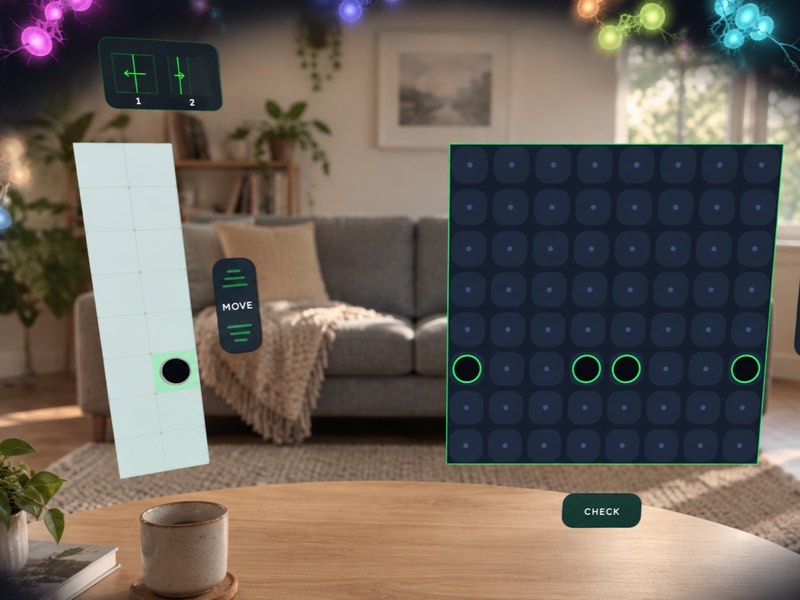
The rule
A punch goes through every layer of the folded stack. Each layer is a different square of the original sheet, so one punch makes several holes. Unfold the paper and they appear where those squares are.
The simplest case is level 1: a 4 × 4 sheet folded once in half. The punch goes through two layers, so you get two holes, mirrored across the crease. Each extra halving fold doubles the layers, so two folds can leave four holes and three folds eight.
The folds you will meet
Halving folds
The whole stack folds in half. Folds along the same direction give a row or column of holes; folds in both directions give a grid.
Short folds
Only a narrow strip folds over. Squares under the flap gain a layer, the rest stay single, so a punch on the flap makes two or more holes and the order of folds matters.
Gate and roll folds
Two short folds on the same axis: from opposite edges (a gate) or the same edge (a roll, which makes three layers).
Diagonal folds
A corner folds across a 45° crease. The hole swaps row and column, and a double diagonal makes a pinwheel.
A worked example
- The right half of a 4 × 4 sheet folds over the left. The stack is now 2 wide and 4 tall, two layers everywhere.
- You punch the stack in its top-left square. That square has two layers: the left-hand square itself and the right-hand square that landed on it.
- Unfolded, the holes are in the top row at columns 1 and 4: the punched square and its mirror image across the crease. Those are the two squares you mark.
Tips
- Unfold one fold at a time, last fold first, mirroring the holes across each crease as you go.
- Count your holes before you mark. The number of holes is the number of layers under the punch, so a quick count catches a missed mirror.
- On a short fold, check whether the punch is under the flap. Under the flap you get extra holes; outside it, just one.
- Use CHECK as a lesson. The unfolding shows exactly which crease you mirrored the wrong way.
Holes with a twist
The same idea comes back in other forms across the levels:
- Reverse punch (level 15): the target pattern is shown and you punch the folded stack yourself.
- Fold in your head (levels 18 and 19): the sheet stays flat and only the diagrams show the folds.
- Designer (level 20): you choose the creases, and any fold sequence that makes the target is correct.